Danielle and I had the pleasure of riding days one and two of the Eastern Mojave Scenic Sunrise Ranch/XP ride. I rode Jazzi day one and Dani rode Jazzi day two as her horse, Lyric was not in shape for the ride. Due to an unexpected rain all day Thursday, we were late getting on the road Friday. Fortunately, we only encountered one traffic jam were interstate 15 meets 215 just below the Cajon Pass in San Bernardino.
The ride camp was massive, relatively flat and less than a quarter of a mile from I-15 (this is the main road to Las Vegas from LA and southern California). This is the good and bad news. Super easy to find, a joy to use, but the incessant freeway noise got to me the last night in camp.
The weather was beautiful and perfect for riding. The nights were cold with ice covering the water buckets in the morning giving way to high 60’s and low 70’s by mid day. Although the wind was cold, it was less than 5 mph and intermittent. Jackets, hats and gloves were either being removed or added both days. It was deceivingly dry. The horses’ hard work was not evident in their sweat patterns.
The views were also deceiving. What appeared to be a relatively short distance away was in fact miles down the trail. This is due to the clean Mojave Desert air and the short stature of the umbikuous (?sp) Joshua trees that are usually less than 10 feet tall. This landscape is a stunning mix of native cacti, evolved through the ages to survive in a land both beautiful and dangerous. I found that the native plants could pierce the toughest jacket, jeans or gloves. The horses found the chollas cacti very dangerous as the spines had tiny barbs that make them difficult to remove. If left in the horse’s legs the spines could cause lameness and infection. This was not a place to brush against the flora as it would bite back.
Jazz, my 7 year old half Arab, half saddlebred mare did very well traveling without Lyric. In camp and on the trail she had the handsome Bubba G to keep her company. I am forever grateful to Karl and Bubba for sponsoring both myself and Dani. No one could ever have a better companion or mentor. And that Bubba, he can fly down the trail!
In true Duck fashion, the ride meeting was short, sweet and to the point. We were admonished to stay out of the washes with the deep sand by using the single track on either side. The maps were a joy with what appeared to be National geographic topo maps and numbered boxes on one side and matching GPS coordinates, mileage and helpful hints on the other. (Now I whine about losing Jerry who knew everything about a GPS and would have loved teaching Dani and me how to use a GPS on the trail. I’ll stop whining now.) A typical hint was turn left here, water at this corral. The trail was superbly marked and the footing, aside from the deep sand washes, was excellent.
Day one was very cold in the morning with ¼ inch of ice in the water buckets. Our phone alarm did not go off. It was a race to eat, get dressed and in the saddle in 45 minutes. Somehow we got all the tack and trappings on in time and we were off in the cold, clear morning air. Bubba and Jazzi had one small disagreement and then settled down. Well, Bubba settled down and Jazzi took a bit longer. We ended up behind Crockett and Sharon for several miles. It was a beautiful thing to see how they moved down the trail taking turns leading, following always pushing ahead, but always safe and sane. Their horses moved along happily listening to their rider’s commands. I am grateful to have witnessed such cooperation between man and beast and between two people.
Now Bubba is something else, an American Spotted Saddle Horse that can fly down a trail at a trot, rack or a canter. And Bubba is always happy to fly down the trail; any trail is fine with him. I never saw him take a bad step, all day. Karl and Bubba are one of the best teams I have ever seen in action. They have logged thousands of miles together and are one of the top rated mileage teams in the nation. Karl would never boast about this, he is a humble man who is happy to be owned by Bubba.
All day Karl and I took turns leading and following, finding the single track, discussing important life issues. Bubba, true to form was fine as long as he was with Karl. Jazzi however, was better leading; something to work on at home. Karl was always on the look out for the ribbons, as he admits to having a bad case of “Ribbon Attachment Disorder.” This syndrome causes extreme agitation when ribbons are not found every few minutes while on the trail. Not a bad syndrome to have if you are a distance rider.
We ended up walking most of the gentle up hill trail in to lunch as by then Jazzi was tired and hungry. We lost time here, but Karl did not complain. At the lunch stop Jazzi was drinking well and eating anything but what I brought for her. Due to the cold lunch was only 30 minutes in stead of the normal hour hold. I stayed a bit longer and let Jazzi eat more as she needed the fuel to get us back to base camp. Again, Karl did not complain.
The ride home went fast as it was mostly either flat or a gentle down hill grade. I am the first to admit I do not like trotting downhill. According to Dani this is because I am an old worry wart. Well, she is right, but we trotted most of the trail home with no trouble. It seemed like we were back in the ride camp in minutes when in fact we finished at about 4 pm. In true XP fashion we vetted out and in at the same time with happy though hungry horses. I was tired and very sore from the new saddle that put my feet too far forward for my liking.
At the trailer Jazzi ate continuously for over 2 hours. Her head never can above the hay bag or her pan of beet pulp. Dani found several chollas spines in Jazzi’s butt that came out easily. Dani was an expert on removing chollas spines as she removed many for riders at the lunch stop while helping with the pulse checks. And true to form no spines were found on Bubba, that’s the kind of campaigner he is.
Jazzi started a new fashion craze, soon to be seen at every ride camp: fleece blanket with contrasting waist band. What really happened is I forgot her clean cooler in the back of my car at home. (I need to finish making my check lists as last time I forgot Dani’s helmet.) Soon it was time for the ride meeting and bed as day two was Dani’s turn to ride. To be continued.
Nancy Reed
Lazy J Ranch
Elfin Forest, CA
Tuesday, February 19, 2008

2008 Far Out Forrest - Debbie Parsons
It wasn't pretty, it wasn't a lot of fun, but we got it done! 5
started the 100, 2 completed--the horse traveling in first and the
horse traveling in last. You can guess which one I was! Ride time
was 16:15; finished at 1:45am.
The sand was the worse that I've seen it there and I've actually
hauled the 100 miles to work on those trails. There had been rain
earlier in the week but just not in the part of the forest we were
riding in so the sand was dry, loose, and deep. And it was warm--
upper 70s/80.
We rode out as a group at 6am since it was dark. It wasn't long
before you could actually see the colors of the marker cards. It was
then that we spread out a bit but the group was still probably all
within a mile of each other. One of the things this ride is known
for besides the nasty sand is the low branches. I had eye protection
for my night portion of the ride but didn't wear it at the start.
Big mistake as I found a branch that went for my left eye. I got a
good whack on my left upper eyelid. Talk about pain! I could feel
moisture but it turned out not to be blood (thank goodness for a
white tissue in my pocket to use in the dark to check for blood). My
actual eye was OK but I had enough swelling of my eyelid that it was
irritating my eye. But on I rode. The first loop was 15 miles with a
trot by into camp and then out again for 15 miles before the first
hold at 30 miles. Not what I'm used to but good training for other
rides. I decided to actually go to my rig after I trotted by to
electrolyte Boomer and to check my eye. This resulted in the other
100s getting several minutes ahead of me. I never rode with any of
them again that day. My eyelid was swollen and fuschia colored but
no open skin to worry about which was good.
The 2nd 15 mile loop contained the worse and longest stretches of
sand. It didn't seem THAT bad on my first time on that loop but on
the 2nd time through, it seemed a lot worse, thanks to the heat of
the day and many hooves along the trail. After the 40 min hold, we
repeated the first loop of the day. Now in the daylight, I could see
long stretches of "moguls" that were made by the ATVs that use the
forest. They are miserable to negotiate--hard to get a rhythm or
find a gait above a walk that feels comfortable so I walked them
this time (last time we trotted them in a group in the dark which
was a weird sensation). When I came in for the 2nd hold at 45 miles,
I got a reminder that Boomer is a bulky horse and just doesn't cool
as well as some of the others I've ridden. He had a poor CRI and low
gut sounds but I knew he'd eat. Unfortunately, my rig was in the
full sun. My bad in not moving some stuff into the woods for shade.
My plan had been to park my rig so I could set up my pen in the
shade but 2 other riders had gotten there early and parked their
rigs horizontal to the shade rather than vertically, thereby taking
all the shade for 2 when about 5-7 rigs could have parked there.
Something to think about when you park your rig. Boomer's gut sounds
came up but his pulse at the end of the hold was 56. Not good. I was
OK'd to go out though and I went out to repeat the sandy 2nd loop
again, this time at a much slower pace. I know I took at least an
hour longer than the prior time, if not more than that. I walked
whenever the footing was even a bit questionable, and handwalked the
last 1/8 mile into camp at the end. Much improved marks going into
the 50 min hold despite limited water on this loop. Boomer ate and
drank and looked good although a bit tired.
The next 4 loops were 10 miles each. I got in one of those before
dark. When we went out in the dark to start the last 30 miles,
Boomer had decided I was truly crazy. He did go out and he did trot
when I asked but it was what I call a "screw you" trot--not much
faster than a western jog. That was his pace and he wasn't going to
go any faster unless I really got after him and I didn't see any
point in doing that, figuring he knew best what he could give me. I
had to deal with this on his first 50 and then did battle with him
to keep the pace down on his 2nd one because he thought he knew the
game then. So we trotted along slowly in the dark. I started
counting 50 strides before changing diagonals. I did this pretty
much the entire time we were in the dark. I bet Boomer can now count
to 50. I think the poor horse was in a state of disbelief and was
hoping I'd come to my senses. Even though he trudged along, he kept
moving. This is a horse that I've thought to be a quitter. He has
stopped on me in the past, taking a lot of urging to get back in
motion but those instances are becoming more distant. If there was
ever a time for him to have quit, it would have been Saturday night.
We had been by ourselves for probably 85+ miles of the entire 100
(we'd caught up with some 50s after 45 miles and rode along with
them for about 5 miles before moving on). We kept going back "home"
and then going back out, leaving food and rest behind. He really
dragged on the last loop until we hit the forest road coming back
towards camp. That section was about 3 miles long and this time he
actually stepped out a bit more. I had told him that he would be
finished this time. Maybe somehow he understood or perhaps he was
just hoping!
The camp was quiet when we finished as all sane people had gone to
bed. I wasn't happy with our final trot-out. Boomer was really
dogging it and didn't look to be moving well or evenly but it was
good enough for the completion. Everything else checked out fine and
Boomer couldn't wait to eat. He ate the best at this ride he's ever
eaten. At the hold at 90 miles, Darlene Krell brought him some
pellets and he almost devoured the feed pan along with the pellets.
He couldn't get enough of the feed or the hay so I stayed beyond the
very short 10 min hold time to let him eat. It paid off.
My friend Cindy called out from her rig to offer help as I untacked.
My mistake was not taking her offer. I had not taken care of myself
as well as I should have. By the time I finished poulticing and
wrapping Boomer's legs, my head was really swimming and things were
getting black. I closed my eyes as I unsnapped Boomer from the
trailer and turned him to his pen. He went in to get to his food and
I got the top strand of his pen done before lying down on my trailer
ramp, hoping the spinning and nausea would ease up so I could finish
what I had to do. It was not a good feeling. After about 5 mins I
got up and finished off what needed to be done outside and then
staggered into the camper. I managed to change my clothes and call
my boyfriend to tell him we were done and I was near death. I set an
alarm for a few hours so I could check on Boomer and was out like a
light. Sure beat dealing with the spinning head and nausea. I could
hear Boomer eating and drinking so I knew he was OK. Should have
known when I started "seeing" deer standing alongside the road that
things weren't going well in my world!
By the time I was ready to leave Sunday morning, everyone else had
already left. I went to take Boomer for a walk before loading him
for the ride home. He planted his feet. It took a lot of
encouragement to convince him to move and when he did get going, he
just dragged along. I felt terrible seeing him like that. I got him
walking and then had him trot a couple of circles around me. He
looked a bit awkward which made me wonder what was lying beneath his
bandages. We continued to walk around and Boomer seemed to finally
realize that everyone else was gone and he was done. He suddenly
brightened up and started dragging me around and even trotting
spontaneously as he spied leftover piles of hay to investigate. He's
a pretty crafty horse; perhaps he was "tired" to avoid more work!
When we got home, I unwrapped his legs--they looked great. I was
happy to see that. I turned him out and watched as he rolled
vigorously several times. He even trotted off to check out the
hanging feed bucket.
He has a sore area on the left side of his back that is something
new. This appeared at 45 miles. I realized as we trotted along in
the dark that I've not checked his saddle fit since November and
he's done a lot since that time. That is a stupid thing to forget to
do. I ride him in a Reactor Panel saddle so it's not like I can't
adjust things for changes in his back. He'd done fine with the 50s
other than loin soreness. This time, no loin soreness but he's had a
loading dose of Adequan, a shot of Legend, and chiropractic work
along with shoes on his formerly bare hooves. There's some soreness
in the girth area that he didn't have on his last 50 (the one
previous to that he did but I changed to a different girth and
thought the problem was solved when he was fine on the next 50).
Overall though, he looks good--his weight stayed up and he's as
obnoxious as he was prior to the ride. He nickered at me a while ago
when I went out to check on him. I doubt it was in greeting . . .
probably a direct threat that if I came near him I'd die! But at
least he looked happy (maybe at the thought of me lying crumpled on
the ground by his hooves!).
We won't discuss how sore I am. Actually, parts of me are OK today
but there are parts of me that are hurting for the first time ever
after a ride. Physically, that marathon I ran the Sunday prior was
easier (I did that in the "blazingly" fast time of 4:52:16 . . . .
Kenyans beware!!). Being up for 22.5 hours is not easy, especially
when the bulk of that time is on a moving horse. I hope this is like
they say childbirth is . . . you soon forget the pain and want
another! I'm still not 100% with my stomach but I'm eating and
drinking.
So, it's done. Now to sit back and analyze the ride and decide if
Boomer did well enough to have a chance at finishing Tevis. I didn't
like the slow and poor recovery. I didn't like the way he was moving
at the final check. I did like how he ate and drank. He did not get
much time for any of his traditional naps--maybe he dozed 10 mins
the entire time because he was too hungry to nap. That was likely
the product of 30 miles before a hold. That length of time/miles is
a good thing when considering Tevis since the first real rest is so
far into the ride. And I did like the way he kept going, despite
being alone and tired. The pace was slow but steady and he did it
for miles and miles in the dark. He was surefooted and didn't spook
in the dark other than to eye a few dark areas of ground
suspiciously.
Boomer gets a month off now. He deserves it and needs it. He won't
see the saddle until it's time to go ride again (at which time I'll
definitely check the fit and make adjustments). Next ride is
Leatherwood, just one day for 50 miles, the last weekend in March.
That will give us some mountain riding. Yee haw!
Thanks to everyone on the list for their encouragement and thanks to
my unofficial crew of Darlene Krell, Thurmon Tolbert, Cindy Ryan,
and Teri Hunter. Without them in those later hours, I'd have been
toast!
Debbie
Monday, February 18, 2008
Riders saddle up for Cracker Trail ride - Feb 18 2008
Bradenton.com - Full Story
By JAMES A. JONES JR.
EAST MANATEE -
With the dying embers of campfires in the morning chill, people lining up for chow as the sun rose, and the clanging of gear and equipment, it almost had the feel of an army bivouac.
Except the uniform of the day was cowboy boots, jeans, and floppy western hats, and these folks would be mounting up on horses, not Humvees...
More...
Shanghai Trails Endurance Ride - Feb 17 2008
Pam' Site - Full Ride Story
Braving the threat of rain and severe weather, we went to the first running of the Shanghai Trails Endurance ride at Pierce Ranch this weekend. We arrived early on Friday since I had promised Cindy, the ride manager, to help her with the ride. Helen pulled my three horse bp trailer with the Kawasaki mule so that we would have extra transport for Cindy.
Friday afternoon, I decided to take Rio out on a short warmup ride. I rode with another friend, Tamsen on the pink loop, which is the 10 mile loop of the ride. We rode out for about 3 miles then turned around and came back. We actually rode pretty fast, but when Tamsen came back and vetted in, her horse came up lame from the heavy mud that we rode through in some places...
More...
Thursday, February 14, 2008
Dr Strangles Or: by Lynn White
Dr Strangles Or: How I Learned to Stop Worrying and Love Riding Alone
Merri Melde's story about taking care of horses with Strangles got me thinking about my own experience with this nasty affliction. Like most every thing with horses (and life in general), destiny comes via the most unlikely circumstances.
For those of you who grew up in the saddle and have no fear of riding, you probably can't relate to this story. But for those of you who took up riding as an adult, read away. There is something about taking up a sport as an adult. It's like your brain is not wired for it and you have to think about everything that you do. Though I'd never want to be anywhere other than on the back of a horse, I took up riding as an adult and my brain is just not wired for it. I have to think about everything I do and I think about all the bad things that can happen on a horse. I worry too
much sometimes.
Part of the reason I like this sport is because I like to yak with my horsey friends. I have to make it a point to shut up sometimes because I just know I must annoy the crap out of people. I can almost hear people thinking: "OMG here comes that lady who will not shut the hell up! Ride faster/slower!"
In July of 2006 I was alone on a conditioning ride and had a pretty serious fall. It was one of those I-could-have-been-killed falls. Nothing really serious happened besides landing on my face and people giving my husband dirty looks at the grocery store. But landing on my face really rattled me. I could have easily snapped my neck. I vowed never to ride alone again (like having someone around would magically keep gravity from being so unkind). I am lucky because I am blessed with living around other riders so riding with someone is about as difficult as picking up the phone.
The season of 2007, PJ Blondshine and I religiously conditioned together and things were proceeding as planned. Then I noticed that green goopy discharge on my year-old colt. If it wasn't for the fact that I handled him daily I would have never even known he had strangles. About the only other symptom that he had was a minor malaise. Instead of charging around the pasture at a full gallop for four laps, he'd gallop just two laps. My mare Agnes had a runny nose and was now considered a "shedder." I had become public enemy number one and would remain that way for the next six weeks.
With several rides left to go late in the season I decided that I was just going to have to ride alone again. So I started giving my husband detailed maps where I was going and with fear and trepidation, headed up to the hills armed with a cell phone and a hunter orange vest. I stayed on the roads and kept to the route I had told my husband (this was the hardest part).
Because there was nobody to talk to I really started to see things and think about my horse in a whole new light. I started seeing all sorts of birds and wildlife. I started to think about stories to write and new places to explore. Because there was nobody to talk to we were a lot stealthier. I found that I liked just being out alone on my mare. The fear of riding alone was gone. If it hadn't been for Strangles I'd still be dependent on riding with other riders. Now at least, I know I can do it alone.
I know that something could always go wrong. I could come face to face with a cougar or Agnes could stumble at a walk and I could end up with a broken femur. I could also end up with cancer in a year or have to spend a couple years taking care of a sick relative and not ride at all. Horses teach us to live in the moment because that is where they always are. Horses force us to relax because they don't do well with uptight people. They teach us how enjoy a sunny day and appreciate all the things and people in our lives, and they teach us how to overcome worrying. Kind of surreal, really.
Lynn
Sunday, February 10, 2008
Freeze R Burn (subtitle: Don't Walk) - Feb 10 2008
Californio.livejournal.com - Full Story
Yesterday was my first endurance race, the Freeze R. Burn 25 mile at the Grasslands in Decatur, Texas.
Okay, so I was afraid. Not that Glamdring wouldn't make it. That I wouldn't make it. That I'd fall off and get hurt. Or some other disaster would happen. Like Mark Twain, my life has been full of disasters that didn't happen. Yet...
More...
Saturday, February 09, 2008
My last day of being 49.....was kind of a bummer
Endurancegranny.blogspot.com
Saturday, February 9, 2008
The Endurance Granny officially turns 50 tomorrow. Today was sunny and the ground was beginning to dry up with reasonable footing. So I figured it was time to get the Phebes out and start working her under saddle. I began with some light ground work and she was just really having a fit, spooking, blowing, and eventually bucking and having a royal episode. I had the crupper on her, so I thought maybe she was having issues with that, so I removed it, and lounged her around both directions and she quit bucking. Thinking I had the bugs worked out I climbed on and walked her a little, then suddenly she tried to bolt, commenced bucking, and I lost a rein before I could get her stopped. She promptly laid me out on the ground with me landing on my head...
More...
Tuesday, February 05, 2008
Lucy's Death Valley Encounter, 2007

Lucy Chapin Trumball tells her 2007 Death Valley Encounter Story
Well, here we are, over a week after DVE, and my legs still feel kinda weird - covered in rough, dry skin from constant abrasion, battering, and friction. I was expecting to feel a bit crumpled around the edges after four days of riding, but wasn't expecting to feel that way within the first 20 miles or so. In actuality, as the days went on, the pain lessened and either my legs went numb from constant insult, or I just loosened up.
But I'm getting ahead of myself.
...more
Human and equine interaction and dependency
D'Arcy Demianoff-Thompson
...an interesting and vital piece of information regarding human and equine interaction and dependency. I never considered this relationship or the degree of importance until I was 45 years old. After a life time, up until 45 years old, with horses in one capacity or another.
When I was 45 I had a serious accident on Samburu KA aka Sammy. He was owned by someone else at the time. I worked him on a regular basis for this owner. Sammy and I had a working relationship in as much as I looked forward to the work and he did as well. I never got the sense that Sammy thought anything, about me, beyond the time we spent together. The relationship seemed to be, "I ride you, you let me ride you, you get a treat, and I will see you next time" type of relationship.
Then, one day, we were riding up on a canel road, in Merced, CA, that runs along the irrigation canal/ditch. The ditch was full of water. Next to this particular stretch of canal is a four lane road. So, water on one side - lots of traffic below, on the other side. If anyone is familiar with the canal system in the San Joaquin Valley you know how many miles you can travel uninterrupted and free of equine traffic. We were approaching a 'bend' in the canal, lined with trees, visibility was minimal. Imagine our surprise, when, around the bend came a run away horse and rider directly at Sammy and I. We didn't have much time or room to navigate out of the horses way. I turned Sammy away from the horse, next to the water side of the canal, to give the horse room to go by. Hoping this would lessen the fractious experience one can anticipate when an offending horse approaches a STALLION. Instead of taking the break in the path the horse came straight into the side of Sammy pushing him to the edge of the canal where he lost his footing. We went, over, into the canal sideways.
I was pinned, under Sammy, at the bottom of the canal. According to a witness, that had been driving on the road side of the canal, Sammy, at his own risk, tried to climb the cement canal, cutting up his pasterns and fetlocks to lift himself off of me. When I got out from underneath him he dropped himself back down into the water. Clearly he was not just trying to 'get out' of the water. Rather Sammy knew I was under him. After I got out from underneath him and held onto his saddle horn, he was able to keep his head above the water line, until someone helped me out and then anchored Sammy, so he could get his footing on the cement, and pull himself out. I was immediately, separated from Sammy and driven to the hospital. As I was being driven away Sammy kept calling after me. At the time, being in so much pain, I didn't think about why he was so upset. Sammy was taken back to his ranch. Needless-to-say I had a few injuries and was laid up for about 2.5 weeks.
I was unable to get out to the ranch where Sammy was located during those 2.5 weeks. I called regularly and spoke with Sammy's owner to see how he was doing. She didn't want to worry me and told me he was okay. Then at the 2.5 week mark she said, "he is okay but he seems to be getting more and more depressed as each day goes by. He is not eating much. When can you come out?" I had someone drive me out to see Sammy. As I got out of the car and called his name he scretched in return. It was one of the most plaintiful calls I had ever heard in my life. I got to his stall as quick as I could. When I entered his stall he dropped his head over my shoulder and ever so gently huggd me with his chin. He took a step back and looked me in the eye with one of his eyes and breathed into my ear with one of his nostrils. He then dropped his mouth to my hands and licked them and kissed the tops of my hands with his lips. I was no overwhelmed with emotions I started to cry and for the first time in my life I witnessed a horse CRY! Tears streamed down his face and he rubbed his cheek on mine to wipe away my tears.
The exchange and experience between Sammy and I was one of the most emotional moments I had EVER had with a horse. Up until that point, over the number of years in my life, the number of horses I had been involved with, owned, or trained, was in the hundreds. It was at that very moment, with Sammy, that I realized how important I was to him. How he came to depend on me. And how he may have felt that he let me down. That he may not have taken care of me as well as he should have. It wasn't until I said to Sammy, "it's okay boy, I am fine, and thank you for saving my life!" That he actually let out all of his breath, relaxed his neck, and leaned against me and breathed normally.
I was amazed and bewilderd by this experience. As I spoke of it to others and listend to similar stories I began to truly understand what lies in the heart and soul of the horse. I was referred to several different books on the beliefs of the Bedouins regarding their horses. One book, I believe it is Bazy Tankersley's, "Ride Away Singing," that explains the Bedouians belief that an Arabian horse, always knows where it's ''owner' (lack of a better word here) is at all times. that the Arabian horse has the capacity to love all humans and only 'bonds' with ONE human. The Bedouians, also, believe the horse knows, feels, and can communicate with said 'owner.' During my recovery process I had 'felt' as though Sammy may have been trying to communicate with me. I dismissed it as 'silly notions' that he would have had any idea where I was or what condition I was in. Apparently I was wrong.
A couple of years went by after the accident. My life became very full of work, travel, and committments to my own horses. I was rarely out to the ranch to see Sammy let alone work him. And yet I never lost contact with Sammy through our spiritual interaction. I woke up one day, I was living in San Jose (2 hours from Merced) at the time, and told my partner, Keith Clanton. we need to go and see Sammy. We talked about the feelings I was having. I told him I thought Sammy was trying to communicate with me and that I really needed to be there. When we got to the ranch and saw the condition that the horses were in (owner fell upon hard times and there was very little hay) I understood what Sammy was trying to communicate to me. We returned to San Jose with the feeling of such sadness. I called a friend who said he would buy four of the horses - Sammy, Cejlon, Czapral, and Iza Fire. Two weeks went by and it was time to pick up the horses and have them transported. I got a telephone call from Kentucky that the buyer had been killed in an automobile accident. I was grief stricken, not only for my friend, for the horses, Sammy in particular, as well.
Again, fate, karma, whatever you want to call it reared it's beautiful head. Keith comes home and hands me the money and says, "go pick up the horses!" That was July 1998. Sammy has lived with me ever since and there is not a day that goes by, unless I am off site, that we do not spend time together. We ride, we play, we talk, or we just have silent moments together. Sammy will be 28 on the 12th of March. I treasure each and every day I have with him. And he has taught me to never underestimate the strength and power of the horse's ability to be at one with it's human.
God Bless you one and all in hopes that Sammy's story inspires you and guides you to never underestimate the impact you have on the horses life.
D'Arcy L. Demianoff-Thompson
Wednesday, January 30, 2008
Land of the Sun Ride Story - Ashley Wingert
Exploits of a Distance Pony - Story and Blog
Wednesday, January 30, 2008
The aches are barely starting and I’m already sitting down to write the latest ride story, which just goes to show how good the ride is…the worse the ride, the longer the story takes to get written, if it even does at all. And I’ve found that in my excitement over the ride, I ended up being rather verbose…so this story kind of goes on forever. All the excitement over a first 50, you know. It’s probably going to be a play-by-play of almost every mile of the trail, so will probably be a little bit boring in parts.
As a bit of a preface/introduction, I’ve been working on getting to a 50 mile endurance ride on a regular basis for the last year…my first 50 was supposed to be Land of the Sun 2007…the night before the ride, one of Mimi’s pasture-mates bit her in the middle of the back, right where the saddle sits. The entire year went that way…
an entire comedy of errors that culminated in me managing to get to 3 NATRC rides
and one LD ride. Not exactly what I would call a stellar year.
The 2008 ride season kicked off with an dubious start…
More...
Tuesday, January 22, 2008
What I Have Learned From Endurance Rides
Midsouthhorsereview.com - Full Story
"It helps to use food, treats, and verbal praise during the rides"
by Monica Rawson
Endurance riding is not for the weak at heart. Endurance riding has challenged me more than any other equine sport, from show jumping, dressage, foxhunts to cross country. Endurance riding has made me a stronger rider and taught me the importance of planning ahead, the value of consistency and how to set long range goals and have the patience to accomplish them one step at a time. I turned sixteen years old this past October and therefore "aged out" of the junior division. Zoie Starlite, my 17 year old Anglo- Arab mare and I have trained for endurance rides for over a year. We live outside Memphis, Tennessee and have been to many rides in most of the surrounding states competing in 25 mile, 50 mile and multi day rides.
Zoie has taught me that to be successful on endurance rides we both need to be mentally and physically ready. I discovered how much preparation is required to build up one's strength to persevere during the longer and more difficult and challenging rides. I learned not to think one race at a time, or even one season at a time. I think about how many races Zoie and I will be able to do over the next 20 years! While most other equine sports place winning, looks, or bloodlines as the number one priority, endurance riding puts the long-term health of the horse and rider as the first priority. Since I want to be an equine vet I agree with this mind-set and hate to see the long-term health of a horse or rider sacrificed for a short-term win. Slow and steady is better than going too fast too soon and suffering a physical or psychological set-back for the horse and/or rider.
To prepare for an endurance ride, my horse and I started slowly to build up our strength, even though we were not particularly weak. I began to ride Zoie for short distances at a slow speed until her muscles grew big and powerful. Her recovery time decreased after every ride and her heart rate would come down quickly as well. Zoie also had to learn how to drink out of mud puddles. I had to remember to carry a full water bottle with me so we would stay hydrated while we were on the trail. Zoie and I would warm up before every ride at the walk and the trot in order to prevent pulling muscles. This taught me about the importance of good conditioning which is necessary for a successful ride. I also learned the importance of preparing for different and ever changing terrains and weather. The safety of the horse and rider depends on proper preparation so you don’t freeze, over heat or get into a bad situation that could result in a pulled muscle, lameness, dehydration, or colic.
Endurance riding also taught me to be aware of the emotional needs of the horse before going out on an endurance ride. An emotionally unstable horse that has not built a trusting relationship with its rider could be very dangerous on an endurance ride. A horse will thrive when they have a consistent training program with the same handlers to keep their mind focused on the rider and the task at hand. When the horse has trust in the rider, he or she will cross streams, bridges, logs, and ditches without a problem. I have also found it helps to use food, treats, and verbal praise during the rides to keep my horse motivated.
Endurance riding also taught me to take care of myself. Before a ride I make sure that I get plenty of sleep, eat nutritious food and mentally plan ahead for the ride. This helps to build my patience and endurance under the stress of a long distance ride. Endurance riding has strengthened the relationship and trust between Zoie and I and we are both physically stronger and mentally confident. . I was aided in this learning experience by my endurance mentor. Jennifer Whittaker, of Mystic Rose Arabians, was my teacher and sponsor for most of my endurance rides, riding her stallion, Summer Saga. This coming year I will likely be riding endurance on a borrowed horse. Zoie is now in foal to Saga for 2008 n we have embarked on yet another new adventure!
More...
Tuesday, January 15, 2008
What the crew thinks of the richest ever endurance ride.
The Sheik Mohammed bin Rashid Al Maktoum Endurance Cup is being hailed as the greatest endurance ride in the history of the sport after the world record breaking victory by UAE rider Omair Hussain Al Beloushi on a 10 year old Arab gelding Charlandre El Sharif.
That all fine, but what is it like to CREW in the most prestigious ride ever?
I've been crewing at international rides for over 12 years - from European Championships to "ordinary" FEI 3 stars; but always in Europe. This was my first trip to the UAE.
From the moment I arrived here I realised that this is an incredible place. I landed at 1.00am local time. The airport was packed with people, the roads were crammed with traffic and the building sites - the seemingly endless building sites - were all working flat out.
That was back on the 3rd Jan because I came over at the same time as our horse. (As trainer, crew, groom and person-responsible-for-all-things-that-go-wrong, it fell to me to be here to meet our horse and manage her through to ride day.)
Next morning I was up early to greet Khadidja du Pont (our 10 year old Arab mare) as she arrived at the quarantine stables after her 19 hours trip from our home in England's Cotswolds.
I continue to be amazed. The stables are of course air conditioned, the vets are on hand to take bloods and do free post-travel analysis for us if we wish (which of course we do) and there is an impressive system in place - backed up by lots of people - to not only enforce the quarantine regime but also to meet all our requests for feed, hay, bedding, buckets, and information.
In all we have 27 European horses stabled in 3 barns inside our quarantine compound with a clearly marked 19km quarantine exercise circuit for us to walk and ride our horses.
And all of this just minutes away from the jaw-droppingly awesome venue - Dubai Endurance City.
I took a trip to DEC a few days before the ride - an army of gardeners were watering the grass and clipping the hedges. The place is amazing.
The other thing that hits you is the profile of endurance out here. I blagged my way into the launch press conference in a downtown Dubai hotel - another well organised highly professional event -with lots of media present. Gulf news the leading English language paper in the region is full of our sport, you'll be familiar with that from seeing their articles on endurance.net. But that's just the tip of the iceberg - the local Arabic language media are just as interested in endurance.
Most days I saw journalist and TV crews around the exercise circuit looking for European riders they recognised to interview. I tried hard to look like an important rider. I guess there is something about me that says "He's only the crew". If we are lucky enough to get an invite again I'll have a T shirt with "I'm also an Advance Level rider" written on it (perhaps in French).
And then, after a few days rest for the horse and a few days riding, my wife arrives and we prepare for the off.
Just when I thought I'd got used to Dubai, race day is upon us.
As if the spectacle of 107 starters ("The largest field ever seen outside of a major championship") isn't enough, you have to come to terms with the fact that the big UAE stables travel in numbers. It seems as if each UAE horse has a whole legion of crew at the vet gate. (Note: what is the collective noun for crew?)
And then there is the vet gate itself. Dubai Endurance City looks even more incredible bathed in powerful floodlights. Big screen coverage on site; 7 different restaurants all alive at 6.00am (heaven help the crew who sneaks off for breakfast right now); you can't help but get nervous.
The race itself was astonishing. You can read elsewhere about Omair Husain Al Bloushi,
We watched - his horse was as bright as a button at the end. But let me tell you about crewing this ride.
In some ways crewing here seems easy - nearly all of the ride is accessible to 4x4 vehicles. You can literally drive alongside the course - hence the movie footage you can see. And this is made easier still by the marking - lots of flags, regularly placed and although many of the stages have common elements there are teams out all day taking away coloured flags from loops now completed to minimize scope for confusion.
But in other ways crewing is difficult. Firstly, there is a great deal of deep, deep sand to navigate - far more than the riders and horses have to contends with because (rightly) they get the best surface and the crews take whatever is alongside. Skillful experienced desert drivers can cope with this without getting stuck, those with less desert experienced or who are just bad drivers can only get through it if they drive at speed. You will be amazed how many Arabs join folk like me in the second category. Secondly there is a huge amount of traffic - especially on the first loop - and no rules of the road (because there is no road?) The organisers provided free 4x4 convoys for spectators; the nearby Bab Al Shams Desert Hotel did the same for their guests - and this was designed to REDUCE the number of vehicles following the riders!!
As you can imagine at the start traffic congestion is at its worst.
When we set off into the jet black of the pre-dawn desert at the beginning of the first 32km stage it was like being in the whacky races. All around us hundreds (literally hundreds) of 4x4 vehicles of every shape and make - including ambulances, police and TV crews. They all flashed through the desert, each one carving out its own route and seemingly oblivious to everyone else.
Every vehicle had two objectives: to follow the ride (and in the case of the crews their horse), and not to get stuck in the deep sand.
As we dodged our way through the cars that had already got stuck it became increasingly difficult to maintain momentum without crashing into someone. Eventually our luck ran out, as I swerved to avoid the suddenly stationary car in front the nose of our car dropped down into a deep trough and we were stuck. Buried up to our front axles we had no hope of freeing our crew vehicle. It was less than 20 minutes into the race, we hadn't seen our rider and we couldn't move.
All around us others were in the same predicament. We saw 2 police vehicle and an ambulance nearby - helpless in the sand.
We watched in desperation as the Dubai Equestrian Club's own tow truck slowly worked its way up the hill pulling out one car after another. By the time they pulled us out it was light and we were worried that we wouldn't get back to the vet gate before the horse. We drove back to DEC arriving just in time to get organised before Janice and Khadidja came in to VG1.
From that point on we left a crew member behind at the venue to ensure we would have some Vet Gate support if the worst happened.
Daylight, the spreading out of the field and the VG1 eliminations greatly reduced the congestion on the track. From that point on, although we had some scary moment, we didn't get stuck again. Many other crews did and it remained a real concerned right through to the end of the last loop.
The business of crewing from the start of the second loop was almost ordinary. We had picked up some bottled mineral water (provided free at the start) to use on the run and we made full use of the water stations - located 2 or 3 times each loop and offering a row of big drinking troughs constantly replenished by the organizers. These troughs gave us an opportunity to refill some bottles and to scoop water over the horse.
We were blessed with cool temperatures all day, so dehydration never became an issue for us.
Again thanks to conditions very similar to our summer back home the vet gate procedures ran smoothly for us. Khadidja du Pont presented to the vet in under 4 minutes (average across the day) and we were being conservative. She breezed through the vettings and the 3 compulsory re-exams. During the holds (30 and 40 minutes) we usually needed to put a rug on her to keep her warm. We used Equi-N-Ice coolant to chill leg bandages too - a big help as much of the course was very concussive.
There was just one other issue for us - fuel consumption. The high revving and hard driving to get through the deep sand pushed fuel consumption through the roof and my hired 4x4 ( a small Mitsubishi Outlander) simply didn't have a big enough tank. Before half way I realized that I was going to use MORE than a tank of petrol (another weakness: because the stuff is so cheap out here most vehicles are petrol doing less miles per gallon that the diesels we have back home).
At one Vet Gate as soon as the horse passed the vet I had to leave my wife and two fellow crew to manage the hold time and re-exam so that I could get fuel. Because DEC is in the middle of nowhere that was a 60km round trip. By the time I got back Janice and Khadidja where out on the 5th stage. I caught up with her as soon as I could, but it did cost us a little as the horse was not as wet as I would have liked leaving the vet gate and I'd missed some early opportunities to crew on the course. At this stage I think it would have been really helpful for psychological reasons as the two were all alone. There pace slipped a little on this circuit and I blame myself for that.
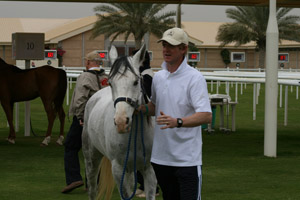
Iain and Khadidja du Pont
Janice was the first British rider to cross the line finishing in 23rd place, the 4th European combination to finish. Not bad for our first trip to the desert.
And after all that it really did feel as if we'd taken part in the most prestigious ride in the history of endurance. Top marks to the Dubai Equestrian Club. What an experience...
Iain Cockely-Adams
That all fine, but what is it like to CREW in the most prestigious ride ever?
I've been crewing at international rides for over 12 years - from European Championships to "ordinary" FEI 3 stars; but always in Europe. This was my first trip to the UAE.
From the moment I arrived here I realised that this is an incredible place. I landed at 1.00am local time. The airport was packed with people, the roads were crammed with traffic and the building sites - the seemingly endless building sites - were all working flat out.
That was back on the 3rd Jan because I came over at the same time as our horse. (As trainer, crew, groom and person-responsible-for-all-things-that-go-wrong, it fell to me to be here to meet our horse and manage her through to ride day.)
Next morning I was up early to greet Khadidja du Pont (our 10 year old Arab mare) as she arrived at the quarantine stables after her 19 hours trip from our home in England's Cotswolds.
I continue to be amazed. The stables are of course air conditioned, the vets are on hand to take bloods and do free post-travel analysis for us if we wish (which of course we do) and there is an impressive system in place - backed up by lots of people - to not only enforce the quarantine regime but also to meet all our requests for feed, hay, bedding, buckets, and information.
In all we have 27 European horses stabled in 3 barns inside our quarantine compound with a clearly marked 19km quarantine exercise circuit for us to walk and ride our horses.
And all of this just minutes away from the jaw-droppingly awesome venue - Dubai Endurance City.
I took a trip to DEC a few days before the ride - an army of gardeners were watering the grass and clipping the hedges. The place is amazing.
The other thing that hits you is the profile of endurance out here. I blagged my way into the launch press conference in a downtown Dubai hotel - another well organised highly professional event -with lots of media present. Gulf news the leading English language paper in the region is full of our sport, you'll be familiar with that from seeing their articles on endurance.net. But that's just the tip of the iceberg - the local Arabic language media are just as interested in endurance.
Most days I saw journalist and TV crews around the exercise circuit looking for European riders they recognised to interview. I tried hard to look like an important rider. I guess there is something about me that says "He's only the crew". If we are lucky enough to get an invite again I'll have a T shirt with "I'm also an Advance Level rider" written on it (perhaps in French).
And then, after a few days rest for the horse and a few days riding, my wife arrives and we prepare for the off.
Just when I thought I'd got used to Dubai, race day is upon us.
As if the spectacle of 107 starters ("The largest field ever seen outside of a major championship") isn't enough, you have to come to terms with the fact that the big UAE stables travel in numbers. It seems as if each UAE horse has a whole legion of crew at the vet gate. (Note: what is the collective noun for crew?)
And then there is the vet gate itself. Dubai Endurance City looks even more incredible bathed in powerful floodlights. Big screen coverage on site; 7 different restaurants all alive at 6.00am (heaven help the crew who sneaks off for breakfast right now); you can't help but get nervous.
Wacky Races
The race itself was astonishing. You can read elsewhere about Omair Husain Al Bloushi,
We watched - his horse was as bright as a button at the end. But let me tell you about crewing this ride.
In some ways crewing here seems easy - nearly all of the ride is accessible to 4x4 vehicles. You can literally drive alongside the course - hence the movie footage you can see. And this is made easier still by the marking - lots of flags, regularly placed and although many of the stages have common elements there are teams out all day taking away coloured flags from loops now completed to minimize scope for confusion.
But in other ways crewing is difficult. Firstly, there is a great deal of deep, deep sand to navigate - far more than the riders and horses have to contends with because (rightly) they get the best surface and the crews take whatever is alongside. Skillful experienced desert drivers can cope with this without getting stuck, those with less desert experienced or who are just bad drivers can only get through it if they drive at speed. You will be amazed how many Arabs join folk like me in the second category. Secondly there is a huge amount of traffic - especially on the first loop - and no rules of the road (because there is no road?) The organisers provided free 4x4 convoys for spectators; the nearby Bab Al Shams Desert Hotel did the same for their guests - and this was designed to REDUCE the number of vehicles following the riders!!
As you can imagine at the start traffic congestion is at its worst.
When we set off into the jet black of the pre-dawn desert at the beginning of the first 32km stage it was like being in the whacky races. All around us hundreds (literally hundreds) of 4x4 vehicles of every shape and make - including ambulances, police and TV crews. They all flashed through the desert, each one carving out its own route and seemingly oblivious to everyone else.
Every vehicle had two objectives: to follow the ride (and in the case of the crews their horse), and not to get stuck in the deep sand.
As we dodged our way through the cars that had already got stuck it became increasingly difficult to maintain momentum without crashing into someone. Eventually our luck ran out, as I swerved to avoid the suddenly stationary car in front the nose of our car dropped down into a deep trough and we were stuck. Buried up to our front axles we had no hope of freeing our crew vehicle. It was less than 20 minutes into the race, we hadn't seen our rider and we couldn't move.
All around us others were in the same predicament. We saw 2 police vehicle and an ambulance nearby - helpless in the sand.
We watched in desperation as the Dubai Equestrian Club's own tow truck slowly worked its way up the hill pulling out one car after another. By the time they pulled us out it was light and we were worried that we wouldn't get back to the vet gate before the horse. We drove back to DEC arriving just in time to get organised before Janice and Khadidja came in to VG1.
From that point on we left a crew member behind at the venue to ensure we would have some Vet Gate support if the worst happened.
Daylight, the spreading out of the field and the VG1 eliminations greatly reduced the congestion on the track. From that point on, although we had some scary moment, we didn't get stuck again. Many other crews did and it remained a real concerned right through to the end of the last loop.
The business of crewing from the start of the second loop was almost ordinary. We had picked up some bottled mineral water (provided free at the start) to use on the run and we made full use of the water stations - located 2 or 3 times each loop and offering a row of big drinking troughs constantly replenished by the organizers. These troughs gave us an opportunity to refill some bottles and to scoop water over the horse.
We were blessed with cool temperatures all day, so dehydration never became an issue for us.
Again thanks to conditions very similar to our summer back home the vet gate procedures ran smoothly for us. Khadidja du Pont presented to the vet in under 4 minutes (average across the day) and we were being conservative. She breezed through the vettings and the 3 compulsory re-exams. During the holds (30 and 40 minutes) we usually needed to put a rug on her to keep her warm. We used Equi-N-Ice coolant to chill leg bandages too - a big help as much of the course was very concussive.
There was just one other issue for us - fuel consumption. The high revving and hard driving to get through the deep sand pushed fuel consumption through the roof and my hired 4x4 ( a small Mitsubishi Outlander) simply didn't have a big enough tank. Before half way I realized that I was going to use MORE than a tank of petrol (another weakness: because the stuff is so cheap out here most vehicles are petrol doing less miles per gallon that the diesels we have back home).
At one Vet Gate as soon as the horse passed the vet I had to leave my wife and two fellow crew to manage the hold time and re-exam so that I could get fuel. Because DEC is in the middle of nowhere that was a 60km round trip. By the time I got back Janice and Khadidja where out on the 5th stage. I caught up with her as soon as I could, but it did cost us a little as the horse was not as wet as I would have liked leaving the vet gate and I'd missed some early opportunities to crew on the course. At this stage I think it would have been really helpful for psychological reasons as the two were all alone. There pace slipped a little on this circuit and I blame myself for that.
Iain and Khadidja du Pont
Janice was the first British rider to cross the line finishing in 23rd place, the 4th European combination to finish. Not bad for our first trip to the desert.
And after all that it really did feel as if we'd taken part in the most prestigious ride in the history of endurance. Top marks to the Dubai Equestrian Club. What an experience...
Iain Cockely-Adams
Wednesday, January 02, 2008
New Year's In New Mexico 07: A Lesson in Contrasts
        | January 2 2008 My own humble experience at the Las Cruces two-day ride amid the hustle and bustle of the FEI qualification attempts was one of strategically conservative riding on two horses the span the spectrum of character and gait. The more I am exposed to horses, the more I realize how drastically different each one is from the next. Knowing the trail on Day 1 would be shared with some fast-moving horses, I chose to ride Red because he would be less distracted by the activity around him. Red is six; I got him just over a year ago and this was his fourth 50-mile ride. The race started at 8 AM – there were only 12 starters in the 50. We left with the big group, and Red settled immediately into a warm-up trot and our pace stayed between 8.5 and 8.9 mph for the 15 mile loop. A couple of riders passed us near the beginning, and we would be passed by other riders on the common trail throughout the day, but we essentially rode the entire day alone. It was fascinating to be out there riding my own quiet ride and to be sharing the trail and getting passed by the Sheika Madiea from the UAE; the King of Malaysia and Valerie Kanavy. There was water every five miles and Red drank from every tank. The late December desert was devoid of much to eat, so Red was happy to get back to camp and his food. Rusty only rode on Day 2 because he was supposed to crew for some of the Malaysian Team, but they seemed to have as many crew as they needed, leaving Rusty to generously crew for me. It is such a treat to have someone waiting there for you at the vet check with a horse blanket, hay, and willingness to trot the horse out for you. The 45-minute hold passed quickly and we were out again to take on the 25-mile loop. We kept a consistent 7.5 - 8 mph trot for much of the loop, and took 3h40 to complete the section. It felt like a long loop to me, but it did bring us to the 40-mile mark. Red drank his way along in five-mile increments; did not falter when some of the 100-milers cantered past us; and kept an amazingly constant output of energy and willingness for the entire loop. His gait remained smooth and relaxed and he flexed nicely at the pole with gentle teasing of the bit. Red is a kind and gentle soul who is much more advanced than I on his path to enlightenment. Back at the check, Rusty worked his magic with me and the horse and had us back out on our ten mile loop on time without any fuss or confusion. The ten miles passed quickly and I was pleased to be finished the course by 4:30, making our ride time almost exactly seven hours. The sun was beginning to hang low and the temperature was beginning to drop. It probably stayed below 52 degrees at the heat of the day. The terrain was mostly flat with good to excellent footing. There was only 2,000 feet of elevation gain over the entire 50 miles. And although the loops took you up and around the local landfill, the trail was pretty and the miles did not feel that they came at the expense of the horse the way a tough trail can seem. Clydea served us delicious food on all three days – from home-made pot roast to the best thanksgiving turkey soup I will ever enjoy. I was in bed a little after 7 PM, leaving the drama and challenge of the remaining 100-milers to others. I would ride Far on Day 2 and I knew his approach to the work would take more skill and focus from me in order to be successful. This would be his second 50, and although he is seven, his mind works at a fast pace and he can be easily stirred up into a tempest if he is not treated with care. I was up at 6 AM, which left plenty of time for horses and humans to eat and get ready. Rusty was to join us today on Rocky, his little bullet of a horse, who is also excitable, powerful, and for whom this would also be a second ride. We waited for the group to leave, knowing that the first 15 miles or so would have to stay as controlled as possible in order for our ride to be successful. We started out with John Teeter, and within half a mile, caught up to Jim and Clydea Hastie. A small herd of cattle were between them and the trail ahead. I had forgotten that Far had spent some time on a cattle ranch (thanks to the great Leslie Spitzer), which would have explained why Far seemed relatively unfazed by the commotion. John rode off ahead and herded the cattle off the trail for the rest of us. Far and I found ourselves at the front of a group of five. He felt like he wanted to explode – his gait had more elevation than travel, mostly because I was holding him back at 7 mph, when he would much rather have been traveling at double digits. His gait was springy and soon John and the Hasties passed us, leaving Rusty and me to gently negotiate our pace. Far would remain juiced for 40 miles – his gait stayed energetic and challenging to ride. He is a horse who is happier when he can move out at a good pace – I am looking forward to getting him to the fitness level to be able to do that. The trail was littered with yucca trees, and he did not like them any more at the end of the ride than at the beginning. Our pace was interrupted from time to time with shies from one side to the other. I was pleased the first loop on this day was the 25-miler. Far’s recoveries were exceptional all day, although he scored a C on gut sounds at the 25-mile check. It gave me something to worry about for the 15-mile loop even though he spent the first check eating constantly. At 40 miles his gut sounds were a B and the last ten miles were nothing short of heavenly. I finally let Rusty and Rocky lead, which I should have done earlier in the day. Far’s head came down; he worked better off the bit and his gait smoothed out. We finished the day at sunset – eight hours of riding time and neither horse had dropped much in their energy levels or attitude. They are both exceptional movers with lots of hind end power and legs of steel. They ate and drank all day. Today, the day after we traveled home, Far is out in the paddock cantering with his Jolly Ball and having a fine time: the ride seems not to have taken anything from him. We enjoyed good Mexican food at the New Year’s Eve Awards banquet, and called it a Day at 9:30 in the middle of a ferocious windstorm. It was the perfect way for me to end 2007: riding two horses on the same trail who took on the task in wildy opposite ways: they are as different from each other as you are from me. My two days on the trail could not have been more different than the FEI competitors whose race was about something much more serious. Happy New Year to one and all and here’s to a life filled with challenges and contrasts! Enduring: Kevin's Blog |
Sunday, November 18, 2007
Don Bowen and Willy, The Flying Horse
Don Bowen's Virginia City Story
It’s with mixed feelings I send this, my VC story.
As many know, I have been applying for jobs elsewhere to move up in the food chain. I was working the Zaca fire and got a call to be interviewed, did so on the fire, and was also notified I got the new job while still on the fire.
Virginia City was an escape for the stress of the impending move and the unexpected passing of my father. He had fallen at his home and never regained consciousness. He was a decorated Viet Nam War Veteran with 22 years of service in the US Navy.
On Wednesday night after work my son, Darren, and I loaded up Willy, the flying horse, and headed North up the 395 to Bishop for the night. The plan was to make it to the fairgrounds for the night. We had already made the last minute calls to Dave and Connie so they knew we were coming. The next morning we were back on the 395 heading towards VC. We arrived Base Camp in time to catch Dave before he went out to mark trail. Darren and I helped with some of the Base Camp set-up then later joined the Ride Management for Dinner.
On Friday I took Willy out for five mile warm and later vetted him in. The vets thought he was off, which he is if I don’t trot him out fast enough, but after explaining who this horse was and that he was the survivor of a 500’ fall, all was fine and we were sent on our way. Also on Friday the Bowman family, Jonathan, Melody and their kids parked next to us. Since this was Darren’s first time crewing and the Bowman’s were next to us this would work out good for us. This would be Jonathan’s new horse’s first 100 and Willy’s last 100 with me. So Jonathan and I agreed on a pace and strategy for the ride. The next morning we started out towards the back and began our plan keeping a steady pace while letting the horses eat and drink along the way. The highlight of the morning was seeing the Wild Horses along the way. Before the first vet check we had the long down hill that gave us our opportunity to get off and run for a while. It paid off because the horses looked great at the vet check. You could tell Melody had schooled Darren on what needed to be done and expected. We headed out from the vet check to the canyon. We didn’t make much time here due to footing. Being a heavy weight and sketchy footing makes me nervous, I’ve walked and rode with Dave Rabe enough through sections like this that I had no problem getting off through this section. When we got to Washo Lake I new the next part would be the hardest for the horses and me. So we stayed a little longer, okay, a lot longer to let the horses eat and drink. My plan was to tail up as much of the climb on the SOB’s as possible while not losing too much time. I managed to tail most of it and had a better horse at the next vet check for it.
When we passed the next vet check I had a big sigh of relief because this is where Whyatt ended our ride a couple of years ago. We headed out the next loop with a group of riders, Dave Rabe being one of them. As we where making the climb I asked Dave if he thought we were making good time. Dave said “if we could make to the top before 7 PM we would have enough daylight to make good time to the next vet check. We never really knew what place we where in and didn’t really care. We had saved our horses all day and now that the night was coming our horses felt fresh.
We passed the next vet check with the horses looking great and after the hour hold we where back on the trail. This time we picked up one of our team members, Vicki Giles riding Robin Hood. The horses worked great together so we got to the last vet check at a faster pace than during the day.
I had promised Willy after the Big Horn that VC would be our last hundred together. So I was honored to finish Willy’s last 100 with Vicki on Robin Hood, and Jonathan on Monty. We left the Cottonwoods with well-fed horses and hot soup in our bellies. The horses knew we where on our way home so the time seemed to fly by. When we got to the finish line Darren was waiting with blankets in hand with and food water for man and beast. The horses walked on loose lead to Base Camp and finished sound.
One of the keys to our success in this completion was a well-run ride by management and their volunteers. Next was a well-worked plan with great crew that was there when we needed them and when we didn’t. This was Willy’s seventh 100 and for the horse who shouldn’t be here, he sure looked great the next day, and thank goodness I have my Advantage saddle. You’ll still see me on the flying horse just not on a 100.
Okay, so next month we close one chapter in lives and begin a new one. I’ve become a good beginner horseman in this chapter and look forward to becoming an even better horseman in the next chapter. More to come on the move………………….
Don Bowen and Willy, The Flying Hors
Hallelujah 100---My first !!!!
Well here it goes. My first one day 100 mile endurance ride!
It was a quite interesting few weeks prior to the 100. First, I could
*NOT* sleep! Every night when I would lay down for bed, I would lay
awake for hours!!! I could just not fall asleep! I would think about
every possible thing that could go wrong and what if this and what
about that, etc. I was going INSANE!
I also kept thinking that Rika was *off* and I kept thinking she was
lame. Had the vet come out and he said she was fine. Ok. So perhaps I
have gone ***INSANE***.
Ok. So the day came for me to leave at 3:30 a.m. with my uncle to
meet Wendy by 5 a.m. to head down for South Carolina. We arrive in
ample time with Wendy arriving shortly after. We load Rika in the
trailer with Danza and move all my stuff into Wendy's new diesel
truck which she ADORES.
We arrive in South Carolina some time in the afternoon. Plenty of
time to set up camp and get the horses all settled in on their Hi-
ties. Luckily, Becke Grams saved us a spot next to her which was
great. Becke is the woman who sold Rika to me. She assured me that
Rika and I were **READY** for the distance. She was a great
confidence builder.
The following day we register for the ride, set up vet check area,
vet the horses and take the horses out for a short spin. All seemed
fresh and more than ready for the 100. Unexpectedly, Danza begins to
sniff the ground with wendy on top. He tried to ROLL! OMG It was
extremely funny! Luckily she hopped off as he began the act and made
him stop before he got the saddle and her new wool pad completely
full of sand. I wish I had my camera!
Ok so back to camp. Visit Running bear. Becke hops on her computer
checking emails. I was going to bring my computer so I could do
schoolwork as I go to an online charter school. But, I figured I
would be quite busy and too psyched to even think about school! Which
was most certainly true!
We attend the ride meeting and I get to visit with Angie and Josie
McGhee. Got to say hi to Jody. They were rubbing it in that they were
at a ride and that she was at *HOME*. Angie kept telling me to go to
bed, but I told her I wouldn't be falling asleep anyway. So Josie and
I talked for a while. I got to meet her horse Cade. I also helped
them set up their pop up canopy at the vet check. I get back to the
tent and fall asleep about 11 pm.
RIDE DAY!
Get up and feed the horses. I get dressed and make sure I have
everything set up at the vet check. Before I knew it we were in the
saddle and following behind a 4 wheeler! YEEEHAW! Here we go.
We were moving at a pretty fast pace and right before the train track
crossing, our group decides to let a bunch of folks past and then we
will proceed down the trail. It began to get light out and we could
see! YEAH! A few miles from coming in to camp for the fly by some of
our group had to take a potty break. It was at this point where Susan
lost her horse. She let go of the reins and he continued on down the
trail with out her!! Becke went after him. There was nothing more we
could do so we continued after about 10 minutes of hanging out to
proceed to camp. Luckily, her horse was caught not much later and
returned to her by Josie. Susan caught back up with us on the 2nd
loop.
We come into camp after 10 miles and let the horses eat and cool off
a little bit. This was not a mandatory vet check but a fly by. We
spent probably a good 10-15 minutes resting here. Then we went out
again on another 10 miles.
Return to camp for a 50 minute vet check. Rika is eating really good.
All A's on her card and we're set to go. I was worried about the 25
mile mark because her 2 pulls this season were both at the first
check doing less than 25 miles. So I felt if we made it past this
point I could stop worring so much. (NOT)
We're out again after a nice long hold. Rika is feeling great. Next
time we come in and we're at the 40 mile mark! YEAH. Some of the sand
is getting very deep with so many horses going through. I believe
there was about 120-140 horses on trail that day between all the
distances! That's a lot of horses!!!!
It's getting quite hot as well. It was sunny and in the 80's. It's a
good thing I clipped Rika. I'm sure it helped her cope with the heat.
Next thing we're at 50 miles! It didn't really feel like we had done
anything. We did the first 50 in about 6 1/2 hrs. That's pretty good
especially since we're going another 50 miles. We wanted to conserve
the horses and keep em' fresh all day. It worked out very well. I
never remember a time any of the horses getting tired. It was a group
of 5 and we stayed together the whole day. From 6:30 a.m. to nearly 1
a.m. the following morning!
I believe we got to the 75 mile mark before it was dark. I had to go
for a recheck at this point :( Otis said he thinks he saw somthing in
the hind end. OH NO. I was so SAD at this point. So I gave her some
elytes and massaged. Went back. I got Angie McGhee to trot her out
for me so I could watch. I'm watching and I thought she looked
completely fine! YEAH! Otis quickly handed the card and I was sooo
thrilled! Ok. 25 miles more to go! We can do this thing rika! Next
loop felt pretty long. Got back in at the 90 mile mark. I couldn't
believe it! 90 miles!!!! Horses vetting through.
Eating/drinking/peeing/pooping. All is well!!!
Getting in the saddle for that last 10 mile loop was HARD! At this
point I was getting tired. It's exactly what I was told by other
riders. You have a different mindset when going 100 miles. I know I
did. I didn't get tired until that last loop and I just wanted to get
done!! We trotted out of camp in the dark on the road to complete
that 100 miles! WAHOO! Rika was not tired. On the last loop, she
didn't really want to lead. All day, she was taking her turn bringing
up the lead and then would zoom up and lead our pack for a while. She
had a great time. It was so nice to see camp coming across the finish
line at 12:53 a.m.! I could not stop smiling!
All day, Becke's trail husband "Dick" crewed for us and met us at the
5 mile mark of every loop. He would have been out there more for us
but that was the only spot he was allowed. He met us the whole 100
miles with water/grain/snacks and jugs to dump water on the horse's
necks. He was truly a savior! Angie and Josie also helped me
througout the day which was great. Josie rode the 50 and then crewed
for me when she was done! HOW NICE :) They were both there for the
finsh. THANKS!
And I did the whole ride on eating pretzels, chocolate pudding,
Quaker chewy granola bars, Kool Aid Gelz, Propel and water. I felt
awesome the whole day!
All 5 of us got our completions that we wanted! Horses did great! I
never knew horses could have so much energy and would do so much for
us! I have a whole new respect for these amazing animals and will
never *EVER* doubt my horse again.
Before we went to bed I had a nice hot bowl of chicken soup and then
finally fell asleep. I woke up the next morning with a smile still on
my face!
Kyle and Rika Pony
stevenshay2002@yahoo.com
Thursday, November 08, 2007
2007 Fire Story - Nancy Reed
Don Huston asked me about how we fared in the fires. This simple question opened my memory and out flowed the following story. I hope you will enjoy it. Yes, this is a true story.
We evacuated on Monday mourning at about 1:30 am as the Coronado Hills fire was cresting the Frank’s Peak to the north of our ranch. This fire was in the hills between Elfin Forest and south eastern San Marcos. I never received a reverse 911 call; a hysterical neighbor called instead. We were prepared with trailer and RV restocked from a CTR that Saturday. We also had dog leashes, cat carriers and personal bags packed.
We were able to get all animals and humans off the property in about 20 minutes. Our horses, Lyric and Jazzi, loaded in less than 4 minutes. My 2 boarders (who do not have trailers) were hand walked ahead of the RV by my daughter to a neighbors 5 acre denuded pasture were they were evacuated later that morning.
We (daughter Danielle, sister Bridgit, 2 cats, 2 dogs and our 2 horses) made our way to the Del Mar fairgrounds amid the I-5 freeway construction and vicious winds. These winds were clocked at up to 80 mph! Once off the freeway we found a long line already waiting to get into Del Mar. It snaked out of sight under the freeway with every kind of rig imaginable. It took about an hour to get from the off ramp to leading Jazzi and Lyric into stalls in Barn “I”. As we inched forward in the line up I was impressed by the courtesy exhibited by the other evacuees; room was made to ensure safe turning, lines merged together without incident.
The scene in Del Mar was both frightening and comforting. The air was thick with acrid smoke and ash. Over head lights gave a ghostly light illuminating a circus of horses, humans, dogs, zebras, goats, alpacas, lamas and even caged birds all seeking refuge into the thousands of stalls Trailer and barn doors became lethal weapons as the wind continued to lash out as if in some mindless rage. Neighs of fright and comfort reverberated up and down the barn isles. Yet Lyric and Jazzi calmly unloaded and walked without hesitation into strange stalls. Their neighs were added to the calipee of sounds as more and more trailers poured into the barn isles. We were safe, we made it without an injury or mishap; prayers answered.
Around me I saw several hysterical owners who were forced to leave horses behind due to lack of trailer space. Still others quickly unloaded determined to rescue beloved equines left in the path of the fires. Many did not have horse supplies, buckets, hay bags, hay, etc. Most of us became the other set of hands, holding doors, filling buckets anything to help our equine comrades in the mist of the biggest evacuation in the history of the state. By 8 am that morning Del Mar was full with over 2,500 animals housed in its barns.
We stayed in Del Mar for 4 nights. All in all it was a good experience. Within 12 hours of our arrival a feed store was set up with stall deliveries. Not only did local restaurants deliver meals, but pet stores donated cat and dog food and supplies. Soap, tooth brushes and all kinds of personal care items were also donated. Even Home Depot donated hundreds of their orange buckets for watering and feeding the horses. The barn isles became little communities ensuring whatever was needed was covered. Feed, water and exercise schedules were posted on each door with owner and animal information. Several horses took great pride in removing and or rendering these useless with slobber, feed or bedding. By day 3 organized teams of volunteers made rounds; watering, feeding, cleaning and walking.
Us humans found refuge in the “Elfin RV” with the AC and AM radio. We had the radio on non stop almost the entire time keeping us updated on the fires that still raged. By some lucky happenstance of events, Elfin Forest was spared this time. The Coronado Hills fire was put out in mere hours due to the sharp work of our unit from Elfin Forest and San Marcos Fire. On Tuesday and Wednesday Del Dios to the south east and Rancho Santa Fe to the southwest took the brunt of it. Our fire department was stretched thin having sent units to both Del Dios and Rancho. As the eastern flank of the fire ran up the Del Dios ridge with the Elfin Forest Recreational Reserve as its next meal, the northern ridges of Rancho Cielo were set with back fires to stop the fires advance into southwestern Elfin Forest and Paint Mountain. By grace and these back fires the south western flank of the fire was stopped in the creek bed below the Bridges at the western base of Paint Mountain.
To the east the fire continued to burn, marching closer to our valley and the eastern slope of Paint Mountain. To get to us the fire had to burn through the top of the Elfin Forest Recreational Reserve and the new Olivenhain reservoir before it could reach Paint Mountain to the west and the Elfin Forest Valley. Elfin Forest Fire had hand crews on the top of the ridge on the west side of the Olivenhain reservoir, waiting to fight the monster. As the flames crested the ridge it swallowed the new Lake Hodges overlook picnic area and continued on. Unknown to most, Elfin Forest had a secret weapon, a local who was a San Diego Fire Helicopter pilot. The secret weapon was in Del Dios making water drops and keeping and eye on the fires northwest flank. As the fire took the overlook he went into action. Somehow, he herded the fire into the reservoir, starving it of fuel. With only one spot fire on the western side of the water, the fires advance was stopped and Elfin Forest was saved! Today our valley and most of the Reserve is ride able. We have a few downed trees here and there, but we escaped, this time.
Nancy Reed
Lazy J Ranch
Elfin Forest, CA
Wednesday, November 07, 2007
Susan's Skymont Story
Susan Sites
My 9 y.o. TWH, Bird, & I have been conditioning several months for this ride (since late last winter) & before that we had a base of six years of frequent, mountainous trail riding (we rode year round, rarely missed a weekend riding, & often rode every 3-4 days in the summertime). When we started really conditioning for this ride, we mixed up some longer, slower trail rides (15-27 miles) with shorter, faster ones (5-15), riding as much as our schedules would allow. We have a place close by where we rode often with a good loop on a gentle hill. We could run laps on this hill, then turn & climb an almost-vertical hill to the top of a ridge then back around to the loop & repeat. We had one place where we could really stretch out with better footing & we did many rides there where we would ride a fast loop, come back to the trailer, change tack & ride out again so he’d learn the it’s-not-over-till-it’s-over lesson. I never did more than two loops like that though (about 15-20 miles worth, total).
My horse is one of those ridiculously “easy keepers” who can ride & ride & ride & ride & still looks pudgy to me. Stores fat in all these weird places & feels squishy when he shouldn’t. So even though he didn’t look like a lean-mean fighting machine, I thought maybe that’s the best he can look!? Oh, by the way, he’s also gorgeous. I know I’m making him sound ugly & he’s not. He looks good, but when you stand him next to a cut, buff racehorse, he’s going to look fat. But I digress.
Later in the summer, I tried to get the only endurance rider I know in my area to ride with me to see how I was doing, but her horse was down so I was left to my own resources. I bought & read The Complete Guide to Endurance Riding and Competition. I read endurance.net articles and ridecamp. I learned that heart & lungs condition first, then muscles, then bone & tendon. Bought a stethoscope to practice C.R.I.’s & pushing the heart up into brief anaerobics. But what’s my gauge for the muscles, the bones & tendons? I read that it takes two years to develop the bones for endurance, but wouldn’t 6 years of mountainous trail riding count toward some of that? Or does it have to be 2 years worth of a certain kind of conditioning?
The amount of information out there is overwhelming, & it makes you feel like you can never be ready to do it. I kept flip flopping wildly back & forth from thinking we were no where near ready to thinking that maybe we were as ready as we’d ever be. I finally decided that if I didn’t just do it, I was never going to & I’d end up sitting in my house reading down into a rabbit hole. So, I entered the Skymont ride to find out what’s what. I entered the 50 because I know that we can go 25. What I want to know is how much farther than that we can go. It would be really nice to win. I mean, this is the “to finish is to win” sport, so we want to “win” even if we don’t win in first place. But if we don’t win at all, at least we’ll get an idea of where we are in our conditioning.
We drove up the day before. We only live 2 hrs away. I had my brother-in-law Mike with me who had been training with us riding his 6 yr old Quarter/Arab cross. We’ve had almost the exact same conditioning work. Very different animals, but we’ve worked around their differences so that we can ride together ok. I had taught Bird to trot & his big trot was about the same pace as Ender’s canter, so along we would go. We even practiced riding & splitting up in case we couldn’t ride the race together all the way.
Anyway, we get to the ridecamp, set up tents & go out on a short loosening up ride about 5-6 miles of the last of the blue loop. Better footing than anywhere we normally ride. Way better. This was going to be nice. Back to camp & the vet in. Not understanding the purpose of the trot-out, Bird thought it best to show the vet all of his gaits plus any gaits he had ever seen or read about. Thankfully, I had Otis Schmitt & he just shook his head at this display & said that there were a lot of them, but they were all straight! We were cleared to ride.
We fed the horses & left for the ride meeting. We have no crew yet. They’re planning to arrive by 1st vet check, so we have to leave the horses alone tied to the trailer while we go to the meeting. Now I almost can’t stand to be out of sight of my horse much less leave him alone in the dark in a strange place for 2 hours! I was sick to get back to camp. About the only things I remembered from the meeting were the cautions that Sat. would be the 1st day of hunting season & the ride property was surrounded by hunting land & they were going to have spotters on the perimeter trying to keep hunters from coming into our area & the one about how we had better not get lost & go off trail at the risk of severe injury to our horse because of old barbed wire all over the place! If I wasn’t sick before, I was sick now.
Somehow, I also got the sneaking suspicion that there could be moonshiners tucked away in the nooks & crannies of these hills. I live close enough to know that this is not as surprising as you might imagine if you aren’t “from around here.” Before the race, I had worried about getting into a wreck & separating from my horse, but now there was no chance of that. If I was in a wreck, I was staying with my horse even if I ended up hanging under his belly with his legs thundering around me! I was already going to have nightmares about my black horse tearing through the woods getting shot at by hunters & bootleggers while dragging 10 feet of barbed wire through some hillbilly’s still.
We “stalled” our horses in the trailer because we weren’t going to spring for corral panels on our first ride & we had never high line tied. We figured that they’d be just as likely to bang on the trailer if they were standing tied next to it as they would be in it & this way they’d be safer & could move around a bit. Well anyway, they were noisy. To their credit, they didn’t just stand there making gratuitous noises banging & pawing, but it was still annoying that every move they made was audible & I felt sorry for our neighbors. At the sound of the 5:00 wake-up horn, I bounded out of bed, got the horses out & tied & watered & eating hay. We were going to avoid feeding a lot of grain on race day, so we fed hay, a few handfuls of sweet feed & carrots & apples & our electrolyte cookies. Beet pulp soaked with apple juice was offered & turned down. It was cold, somewhere in the mid thirties I guess. Our neighbors were not growling at us over our noisy trailered horses, not even when I interrupted their pre-race preparations to ask a silly electrolyte question, thank you Angie! As a matter of fact, everyone we met was as nice as could be, the riders, management, volunteers, farrier (especially the farrier), vets, camp dogs, you name it. Nice as could be. Apparently even behind our backs, according to our crew.
The Start loomed like a dark, scary cloud over my head. Crowds are not my thing, especially crowds on horseback. I was too nervous to eat. I just wanted to make it through the start & get out there to ride my ride & find out what I came here to find out. We checked in with the timer & warmed up back out of the way where we could see the start & sneak out when we felt comfortable. We watched the start & it was calm & controlled so (huge sigh of relief) we set out just a couple of minutes after 7:00.
It was chilly & the horses were feeling great & loving the footing & there’s race energy in the air, but Bird wasn’t getting too carried away. We were doing about as well as I could have hoped. I tried to use a group of people ahead of me as a block to keep him from moving out too fast in the beginning & we clicked along. We finished the 1st 12 ½ mile loop in 1 hr, 44 minutes. We were close to last; I think the timer said there were 7 behind us, so I felt good. We were turtling, right? That’s good, right? Well, we felt good anyway. The trail was beautiful; the horses perfect & happy. We were calling them “racehorses” to boost their egos. After all, it may be the only day they ever get to be racehorses, so they needed to milk it.
At camp, our crew had arrived & my nephew met me coming in, handed me a pimento cheese sandwich & took my horse. God bless him. It was great to have a crew. There were so many little things going on & so little time. If you don’t have a crew, you’ll need about 10 long arms & an organized mind, & the latter may be the bigger feat. I know that I didn’t think clearly all weekend, because one of the big side things I wanted to accomplish was to get one of Angie McGhee’s books & I talked to her twice & still forgot to ask her! The horses had pulses in the 40’s & all A’s on the vet cards. They were pooping, peeing, & eating, same drill as this morning, hay, carrots, apples, little sweet feed, even some of the beet pulp. Not drinking yet, so we stashed our electrolyte cookies for the road to feed when they started drinking. My concerns about racing Bird in shoes that were only 3 days old were fading away to memory.
2nd loop was a bit slower. Ender had been a little off in his first trot out & we thought it could have something to do with him being “springy” on the 1st loop (he gets like that when he’s behind Bird ever since he learned that he was entered in an endurance “race!”), so we switched positions. Still no problems out on the trail, two good horses under us, powering on, but adding in some more walking. We did lose the trail a few times, but recovered quickly. The trail was marked extremely well, but with lots of fast weaving in & out of trees, it only took one blinding ray of sunshine to miss a turn & you’d be off course, sweating the barbed wire hazards.
We finished that 12 ½ mi. loop in 2 hours. Now, if you’re watching the math, you’ll notice that we’re not flying down the trail here. But, it is the fastest we’ve ever done that distance. We’ve ridden that distance (25+ miles) & we’ve ridden that fast 5-9 m.p.h., but we’ve never ridden a whole 25 miles at 7 m.p.h. So, at the ½ way mark, we’ve already done more than we’ve ever done before & I’m proud of my horse.
In the 2nd vet check, I’m not completely thrilled with the trot-out, but the way Bird is flipping channels on the remote, I don’t know how anyone can tell anything about him. Shifting gaits about every 3rd step. He doesn’t do that at home when we practice trotting out, by the way. But, he’s still in the 40’s & all A’s except for one A- in the gut. I realize that if we had taken the safe route & entered the 25, we would have finished with flying colors, so I’m happy to know that.
The vet did a C.R.I. at that check which I didn’t realize he was doing until the very end of it & I was standing there just talking to someone not helping Bird at all, not even looking at him. I thought it was bad (for the ½ way point). It was 42/48. I was concerned about it, but maybe it would have been better if I had been paying attention (I can drop Bird’s pulse 3 beats just by touching him on the mouth) & the vet said it was fine. I wanted to talk more to the vet about how we were doing because I knew that my real challenge was about to begin, but he was very busy with all of the 25 mile finishers coming in. I told him that my horse still had plenty of forward motion, but he was getting slightly tired already. He said that was normal, that he should finish the ride slightly tired or it would indicate that I wasn’t doing enough miles. I said, “But we’re only ½ way.” Then he told his helper to give me my completion. He had thought all along that I was one of the finishing 25’ers. My number “2” may have looked like the letter “Z.” She told him that I was a 50. He said that Bird was “cruising.” So off we went.
I was really stressed leaving out on that 3rd loop, but Mike reminded me that they would have stopped me if I wasn’t ok to go. Bird had finally taken a good drink in that 2nd hold too, so all systems were a go. But I knew that it was going to be tough to get him moving, especially since he really gave it his all on the 1st 2 loops. Joe’s advice from the new rider meeting was ringing in my ears, “At this point, your horse will have lost a whole lot of respect for you.” From Bird’s point of view, what possible need could we have to go back out & do it all over again? Sure enough, he was sluggish, even stopping here & there. As far as he was concerned, we were still close enough to camp for me to change my mind & he wanted to give me a chance to do that.
We pushed through that rough beginning & got moving on the 3rd loop. After a few miles into it, things really improved & we were cruising along, no worries. Good forward horse, at least when his GPS told him we were turned toward camp (love that equine GPS – saves me a bunch of money!). When we passed the ride photographer, Linda Toups, I told her that the next time I saw her I was going to strike a pose standing up in the stirrups pulling my underwear down since I seemed to be doing a lot of that!
Then the trouble started. It started very, very subtly. I normally switch leads & diagonals back & forth during rides to keep the horse from getting one-sided. Now, when I tried to pick up the left diagonal at the trot, it was awkward (I don’t know if I’m saying that right, it would be the diagonal when you’re rising with the left front leg, whatever that one is called). I was having to step down in my stirrups to push myself up into the post instead of riding his movement up. It’s the right rear leg I should be getting impulsion from at that point, right? If I had connected dots, I would have known at that moment: my horse is going off & he’s going off in the right rear. In any event, I wasn’t sure what was going on because I know that the rider can get lop-sided too, so was it me or was it Bird? I should have realized that it wasn’t me since I didn’t have an ache in my whole body. I was feeling great, like I could ride a hundred miles. Anyway, all that pushing off was hollowing his back out & making things worse, so I stopped posting on that side.
While this is happening, the weather also seems to be getting chillier. The wind is picking up & I feel like whenever we slow down, the muscles are cooling & that’s not good, so we try to keep moving out. I’m trapped between wanting to slow down because he might be getting tired & needing to speed up to keep from getting cold & sore. I had been so eager to get rid of that rump rug after the 1st loop because it was getting on my nerves, but I wished I had it back now. When we got to the lake, we stopped to offer water. We only stopped for a couple of minutes. They needed to drink, but the stopping wasn’t good either. Not long after we got back on trail, I felt like he was more off. I tried to press on a bit, maybe warm back up, but it wasn’t long before I decided that that wasn’t going to work. We were done. & we were 3 or 4 miles out of camp. I got off & walked. I was so very proud of my horse & told him so, but I had a hard time looking at him because his eyes were so big & innocent & there was a ring of white salt around them from his effort & I had asked him for more than he could do & he was looking at me & I had put him here. It was a long, hard walk.
Before the race, I had imagined getting pulled & this is how it went: we came into the 2nd or 3rd vet check kind of tired & the vet told us that Bird was fit to continue, but that there was a very good chance that at the next check, he wouldn’t pass, wouldn’t get a completion anyway, so I’d have to decide whether to keep going or not & then I would decide not to & we would quit while we were ahead. I always assumed that my decision not to continue would happen at the vet check. In camp. Well, that’s not how it happened. & this is where I can maybe be a cautionary tale for someone. Things may not go exactly as you plan, so plan for the other ways, too. Pack Kleenex.
We plodded on into camp. My ache-less body now a thing of the past because my knees are screaming from that hike. The trail I had thought was on the milder side of technical was a whole lot more tricky when you got down there on it! I didn’t even notice the time. I think it was 3 hours or so on that loop. We’re done. Who cares. We come in & head straight for a vet. Ender was already in & not ok either, waiting to go for his 2nd check. The vet check is a blur to me. I wasn’t paying much attention except to hear that it was muscular in his right rear leg. Ender’s problem was exactly the same, right rear. Weird. The vet does say that everything else is A-ok, they’re not even dehydrated. Apparently, his muscles just fatigued out. He said that I could give Bute if I wanted, but I didn’t because he didn’t suggest it, he only said that I could when I asked him about it. I decided to wait & see & give it to him the next day if he wasn’t better. He never needed the Bute, but I did apply liniment that night & the next day. Ender was the exact same.
So our conditioning was only enough to make it 35 miles. Now I know. Looking back, my feeling is that our conditioning was more weighted like we were entering a mountain bike trial & instead we entered a street bike race. My nephew said that our horses’ bodies compared to the others looked like the difference between hikers & runners (notwithstanding the difference in breeds). I think that maybe our conditioning didn't have enough extended periods of speed. We may be reaching those speeds in training, but we’re not holding them long enough. I’m also unsure about the race day feeding plan. Bird seemed ravenous afterwards. He’s always a big fan of food, but he was Hungry. If you don’t want to feed a lot of grain, but your horse won’t eat the beet pulp, do you go ahead & feed the grain so that at least he’ll have the energy source? I fed Bermuda & Orchard grass hays. Should I have started him on some alfalfa before the race so he would have had that as another option? I wish I had done that. Bird loves alfalfa. I should have bumped him up to a performance feed before the race, too, instead of his usual 10% sweet feed.
Anyway, we’d really like to give it another try next year. So, if anyone out there has any helpful advice, I’d love to hear it. Anything about what to add to our conditioning program, or especially any ways to test the horse to know where he stands along the way. We were lucky on Saturday to meet a super nice experienced rider, Cindy Bell, who just happens to live close to me at least part of the year & she invited us to condition with her next year, so that should help a lot! I know that she had lots of helpful comments after the race & maybe if I can talk to her when I’m not worn out & brain dead, I’ll retain more of it. If anyone else out there can help me, please do. I would especially like to hear more people tell me that since we weren’t pushing our horses hard & the trail was not difficult, that I probably didn’t damage my horse’s bones by riding him until his muscles gave out. The vets didn’t seem to think it was a big deal at all, but pushing my horse’s athletic abilities is a new experience for me & I want so much to do right by him & never ever harm him in any way whatsoever!
I imagine a lot people will read to the part where I say that Bird is a Tn Walker, stop, circle that part in red ink, & yell, “Hey Susan, I found your problem!” That’s what the ride farrier said. Bird is one of those heavy-bodied horses, & he doesn’t have his capillaries right under the skin all convenient-like, either. But I’m not expecting him to win in first place or anything, I just want to win, to win in any place would be alright by me. If I wanted to be competitive, I could go out & buy an Arab. But then it wouldn’t be Bird. & we’re a team. I love him. Why would I want to do this with anyone else? So, I’d especially like to hear tips from riders of the heavy bodies because that’s what I’ll be riding. We won’t be entering 100’s, but completing a 50 would be nice.
Thanks Larry & June & Gary, for putting on this ride & making it a pleasant experience even when it was such a gruelling one at the same time. I won’t soon forget it.
Susan (& Bird)
Thursday, November 01, 2007
The Billeous Blessing

Posted by horsewoman under B&B doings, Horsing Around, Reflections
The air of heaven is that which blows between a horse’s ears — Arabian proverb
There is a passion in the horse that is part of his spirit. The horse is born to love us without conditions attached . Horses and humans are on a parallel journey to help each other. It is by understanding this that we start to unravel our own mystery and potential.
As a long time ultrarunner and and recent discovery and passion for all things equene, the desire and leap to do endurance riding hardly surprising. Alas, to find a suitable equine partner for the challenging, daunting adventures ahead. I’d originally wanted to use my TB mare Picken since we’ve become equine soulmates. Her age and overall constitution dont really lend itself to it and while her heart would be in it, I feared it might compromise her long term well being.
Aha.. the hunt was on. What I was looking for was the “endurance version of Etched”, my show horse… a “been there done that horse.. knows and loves their job and can teach me.” By the grace of G-d and the super supportive endurance community, I was led to long time endurance horse trainers and competitors at The Lost Juniper Ranch in Idaho… Long story short, our Billy a 10 year old Arabian fit the description.
In a series of what I can only dub as “g-dincidences”, and kindness of these folks, the purchase of our Billeous (so nicknamed by his former owner):) was uncharactistically swfit and smooth (hmmm much like his Arabian constitution methinks). He arrived early this afternoon ; courtesy of the owners of the ranch.
Needless to say I was terribly excited to meet Billeous and we did my customary kiss on the nose and said a shehecheyanu A sweet fellow, fairly non plussed by his 5 hour + journey, seemed to take in his new surroundings and new owner with relative calm. A much smaller horse at 14.3 hands, another plus for me being slightly height challenged… Picken and Alle both are almost 16 hands. Carol and Rick proceeded to show me the Specialized saddle that they’d custom fit for him. Awesome on his back and my tush both.. ! He’s out now in adjacent corrals getting used to his new equine family.
So as the good folks in Idaho bid farewell to Billeous, so he and I begin our endurance and life journey here in Montana I am once again reminded of the circle of life. Those of us who spend time with our horses tend to devote lots o’ energy in understanding what the horse is feeling, “saying” and determining what makes our equine partner happy. What we sometimes forget is to use our time with horses to look inside ourselves and ask that same question … As we start our journey together, I can only imagine the lessons my Billeous will teach me about myself. Welcome home , Billeous
Trot on friends, trot on.
Read also: The Billeous Farewell
Subscribe to:
Posts (Atom)